Tuesday, April 28, 2015

Achievement

It took a while (partly because I changed regions) but I eventually got my Black Belt plaque today. 

After months working hard to get certified and not letting anyone alter my determination, it feels real at last.

I remember years struggling in math classes, teachers and fellow students but also former colleagues not believing in my skills. I remember the pain I felt during BB training trying to understand the concepts and fighting not to fell behind. I remember the surprise of some when I passed the written test and then the project presentation.

I've grown through all of it. I became stronger, learned more skills, proved myself to the business to the point that I got that position in North America I wanted so much. 

Don't let anyone walk on your dreams or tell you that you won't be able to accomplish it. If it is in your reach and you put the right amount of efforts to it, you may certainly will.

Thursday, April 23, 2015

Travels tips from an introvert

Before I start a post on how I plan my travels, it’s fair to share my vision of travel first. To me, traveling is about discovering new places, new cultures, new ways of living and eating. It is not necessarily about meeting people, but it certainly is not about sun tanning on the beach all day. (First because I hate sand, second because I don’t like to be in any pool of water bigger than a bathtub and third because I’d get bored too quickly).

I’ve been lucky enough to get the travel bug from my parents and that my husband has it too. Traveling more and more together, we found an organization that works for both of us and was definitely a necessity for our 3 weeks road trip / honeymoon. Here are a few highlights of how we prep for travel:

  • Choose the right destination. I don’t necessarily like to visit highly recommended places (like the French Riviera) and often prefer more authentic ones (like Brittany). It is about finding a destination that you like, that you’ll be able to visit comfortably for your budget, with the right travel time/length of stay balance.
  • Define what you need in an accommodation. To us, Wi-Fi is a must and we don’t like to pay to park. We’d rather be a couple of extra miles away from the place we visit and get free breakfast. I’d choose cleanliness over comfort any day.
  • Don’t underestimate your time on the road. There is always something that will make you lose time on the road so you need to keep a buffer in your day. Also, spending a full trip in your car is no fun. And following a promising sign can be fun!
  • Search for information and advice. When mapping out our road trip to the US West Coast, we joined a forum to get ideas of places to go and a feedback on our itinerary. This was really helpful, but we also chose to keep some visits that are not popular ones (Apple HQ) and skip some classical ones (Lombard Street in SF). This is your trip and needs to be built for you.
  • Plan well but not too much. As an introvert, I like to know what I’m getting into. So I plan what to see in a spreadsheet with estimated duration, cost, address and any relevant notes. I don’t go as far as to put a timeline in there (unless we are not staying long in the same place) as we would have a difficult time to stick with it. It’s also a good way to make sure you don’t leave the place with regrets of visits you missed and places you didn’t know about. My spreadsheets usually have date, address, name and description of what to do/see, budget and planned length.
  • Because you plan the trip doesn’t make it about you. Plan activities and visits that will make your travel companions happy, even if that’s not one of your priorities. I’ve booked an ATV morning for my husband and ended up liking it as much as him.
  • Even out days and nights. After a light day (pool, shopping…), you can plan an evening activity such as a sports game or a show. I wouldn’t pack them all on the same day, but that’s our way of travelling.
  • Pack cleverly. Obviously, take into consideration weather, activities planned and duration of stay. I always make sure I have on me at least our most frequently used medicines, something warm, protection from the sun, water… But I also let some free space for what we’d buy there. I used to pack books but now a loaded iPad is all I need.

While there, we always amend and adjust our stay depending on factors such as weather, tiredness, unexpected extra activity etc. I’m usually the one behind the camera while my husband uses his iPhone and we share the GoPro. I like to keep notes of my days, especially if I want to blog about it or if it’s a special / long trip.

To me, a good trip balances tourist must-dos and places natives like to spend time in. It’s a great way to discover new cultures and ways of life, to make memories that will last forever.

Tuesday, March 17, 2015

Getting healthy: bye bye Coke, hello gym!

Moving to the other end of the earth is a great opportunity to change your habits, get rid of what you don't like or is not good for you and do more of what you want to start. Right after we moved, there was always a good excuse to eat outside, not to get information about the local gym or make any of the changes we wanted to make. 

A month and a half after, I felt comfortable enough in my new life to get out of my comfort zone again and push the door of the gym. After visiting and talking membership, we subscribed for a two year period with the warranty to be able to stop it if we were to move back to France.

The first session with a trainer was a big eye opener. I knew I was not in good shape, but I thought I'd be healthier than I really was. I also thought I was bad at math and sports alike and that I disliked both. I discovered during Black Belt that my maths skills are actually decent, and I discovered during the past two weeks that if I put my mind to it and follow good guidance, working out is actually something I can enjoy (and eventually become decent at). We now have a session a week to learn new exercises focused on our needs.

When our trainer gave us our meal plan, I immediately rejected it in my head, thinking it'd be too hard, that I'd starve, that I'd been there before and that it wouldn't work for me. I actually had a hard time falling asleep that night, going over and over the rejection of that new diet. But then I tried it with a few extras for a week and quickly adopted it. I can live eating chicken everyday and the choice in veggies that I have is actually decent. The only thing I miss is fruits (except for apples that I can eat now).

While I was drinking at the very least a liter of Coke Zero everyday, I started drinking a gallon of water instead. The change happened overnight and without much frustration as water is preventing me to want to drink Coke. 

After two weeks of working out four days a week, I start to see changes on and in my body. I used to loose a lot of hair, I don't anymore. My nails are healthier and my skin looks better, even though I've got a skin allergy that I don't know the cause of. I have a lot more energy to accomplish chores and all that I didn't had the time to before. 

This new life style forces us to cook a lot more, and I enjoy spending time in the kitchen with my husband. Granted we can't cook like we were used to, we can at least use onions and spices to make our food taste delicious. Ironically, grocery shopping is a lot faster (if not cheaper) as we only visit half the supermarket. We also started to plan our meals for the week using our cook books and modifying the recipes (or changing the sides for instance). Cooking more also means cleaning more and keeping the house in better shape, which is a lot nicer to live in.

I had to change my hectic bedtime routine to make it more structured so it fits my gym oriented needs: thoroughly clean my face, hydrate my all body, drink more water, stretch and the most important: get a good night sleep. 

It's only been two weeks but I love it so far. I always look forward my next work out and improving my performances. Unlike the last time I visited a gym frequently, I understand that it is not an mean to an end but a way of life. I'll need to work out and drink lots of water all my life, especially if I want more flexibility with the food I eat. I now understand that healthy people exercise too, that you don't need to spend 15 min doing push ups but you should alternate several repetitions of each exercise, that you may not want to do a full body work out at once.

I'm no expert and it's going to be a while before I feel comfortable sharing tips that work for me, but I'd recommend getting the help of a trainer / someone who exercises regularly if like me you decide to take the path to health. It can be pricey, but a quick calculation tells me that what we pay today for the gym and trainer doesn't exceed what we use to spend in take-away (that we banned as much as possible).

Friday, March 13, 2015

Five first learnings from my amazing new boss

I've been told that you don't change job, but change boss. I quite like the saying. Part of the decision about taking this new job abroad was linked to my new boss. He was one of the teachers for my Green Belt and Black Belt and I knew we got along and that he is a great guy with values I adhere to. I knew I'd gain a great boss and that I'd learn a lot, and he didn't disappoint!

I've only been there for two months, but here are my learnings so far:
  • He's the first boss I've had who asks me what he can do to help me. Every single day. By removing some road blocks or answering some questions, he is making sure I'm performing at my best. And this is not only about work, as I moved abroad he is always happy to help with personal questions too!
  • Get ready for meetings. Like 100% prepared. His expression is "let's review the agenda". It made me smile at first, but when said meeting was starting, I found out I was really confident about what needed to be achieved and how. I feel a lot of meetings could use more prep, in not only the slides but knowing what you are going to say, how you want to react if anything happen, what is your timing for each item on your agenda, who's talking, who's taking notes... Now I feel like I need to go over the agenda and the flow a few times before each meeting, and it feels good!
  • One big Excel book per project. Use tabs and put pain points, solutions, FMEA, B&E, parking lot, etc. in the same book. As long as you rename your tabs, it will make things a lot easier to find back and share with your team. It really shows how organized you are and how much work, time and effort you put into the project.
  • Learn from your team. Even with years of experience and skills way above mine, my boss is willing to learn from me if I know something he doesn't. Usually, it's a MS Office/IT question, but still, it takes humility to have that attitude.
  • Praise when owned. I don't know if it is a cultural difference, but I have received and witnessed a lot more recognition in here that I'm used to. Nothing boosts me better than a thank you and it sure is much nicer to work in that kind of mood.
I'm sure I'll be adding on to that list over time, but these few simple facts have a great impact on both the quality of my work environment and my performances. I'm never one to slack, but I'll give more, be more loyal and supportive when there is that big of a trust and respect between my boss and I.

Dan, if you read this, don't change anything!

Monday, March 9, 2015

Taking a break?

I haven’t blogged much lately. Well, not in English anyway. Let’s figure out why.

  • I started this blog at a time my career was not fulfilling. This new opportunity however is full of challenges and I don’t feel the need to research and work on content. On the other hand, I created my French travel blog to share with my friends and family pictures and a recollection of our travels, and this new adventure makes me want to share a lot with them.

  • English. Living in France, I was a bit frustrated not to use my English enough. Now that’s the language I use all the time (except at home, where we tend to be between the two languages all the time).

  • In here, I am a Lean Six Sigma expert but unlike France I don’t know everyone and have little access to information that I acquired during the past seven years of my career. This is an uncomfortable position, and though I could take comfort in blogging, I often feel too self-conscious to do so.

  • I thought I could just translate some posts and make them work on both blogs. Actually, what I need is to relate what I live from the France point of view on my travel blog and from the American one in here. This would take me minimal effort as most of the content is in my head, but I don’t feel it would be interesting.

  • I’m making changes in my life that I could / should document somewhere. But how can I talk about small changes (how I now prep for meetings for instance) when I am still experimenting? How can I talk about my journey to get healthy when it has been a week?


As I write these lines, I realize that I could tell you about my new (awesome) new boss, about what I like or not so far in the workplace here, how I try to make my cubicle more homey… This is clearly not an end but a simple break to come back with hopefully good content. 

Monday, February 16, 2015

Standard deviation made easy

It took me a while to get comfortable with standard deviation. Even though it was explained to us thoroughly during Green Belt and Black Belt training, I used it without really understanding what was behind it. 

The big epiphany came while working for my Black Belt exam and getting my hands on Six Sigma for Dummies. It was the most brilliant explanation for it and I was glad to share it with my new team as we prepared our upcoming Green Belt training. Let me share it with you.

The standard deviation is the average distance between your mean and your data points. I know. That sounds almost too easy, but that is literally what the formula is. Let’s look into it in details.

Let’s take pizza delivery as an example. Whenever you order, you ask to be delivered at 7:00PM, hoping to be delivered no earlier than 6:30PM but no later than 7:30PM. These are your specifications limits: LSL=6:30 and USL=7:30. 

Over a year, you record the delivery time for each of your orders and plot them into a histogram. Obviously, you’ll want to calculate your mean to get the position of your data set. 


If we look at the mean, it seems acceptable. Though, imagine getting your pizza delivered at 4PM (or even 9PM) when asking it for 7… Let’s have a look at the spread of our data now. The bell curve is not really sharp and we have already pointed out some outliers.

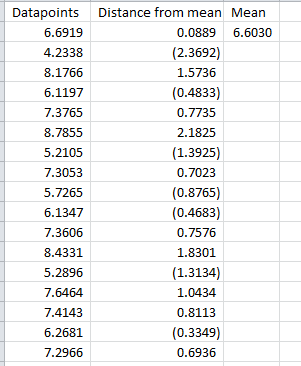
What we need to know is how far are our data points from our central location. To get a real vision, we need to measure them all and compute a mean.


Our new concern is that we have negative values now (everything on the left of the mean). Even if sometimes we wish we had negative minutes, that is not going to happen anytime soon. 

Without going into too much details, our best option to get absolute data (no negative sign) while respecting mathematical rules, is to square our second column (as a reminder 1 x 1 = 1 and -1 x -1 = 1). This is what is called the variance.

Well, now we have square minutes (and way much that the initial distance calculated). I would like a handful of them every time I hit the snooze button of my alarm clock! But realistically, this is as useful as negative minutes. So now if we take the square root of this value, we get realistic minutes back.

Again, the standard deviation is only the average distance between your data points and your mean. To get it, you have to do a few mathematical pirouettes, but hopefully Excel, Minitab and other statistical software will do it for you!

Thursday, December 18, 2014

Opening our first American bank account


After a long and complex visa process, we thought opening a bank account would be somehow tedious. We were wrong! We started by requesting an appointment online at our nearest Wells Fargo. They even sent me an Outlook reminder, which is absolutely awesome and something that every bank should implement!


 Once the time was right, we went to the bank and joined the line. After telling the lady from the front desk about our appointment, we ended up in the (very open) waiting room. The bank Manager says hello and offers us a coffee before coming back with two stuffed ponies under him arm to his office.

The waiting room is crowded and quite not our usual French waiting room with its traditional wood furniture and its lack of confidentiality. We eventually made it to Monica’s desk.

We explained to her our situation (as if the accents were not enough to identify us as Frenchies!) and what type of accounts we want to open. She kindly explained the Credit Score system (which to us sounds a lot like buying supplier’s trust through interests and debt). We fulfilled the usual forms, gave her our passports and the money to deposit on both our checking and saving accounts. We didn’t have a US address or social security number yet, but no worries!

We left with a debit card (with neither name nor chip, which will be the novelty of the upcoming months when it is standard to us) and a check book per account. We also leave with a pony because we asked nicely. It seems like we’ll be well treated in there!

So in short, we spent more time waiting that actually opening the account and the most difficult will be to get used to this banking system so different from ours…