Showing posts with label green belt. Show all posts

Monday, February 16, 2015

Standard deviation made easy

It took me a while to get comfortable with standard deviation. Even though it was explained to us thoroughly during Green Belt and Black Belt training, I used it without really understanding what was behind it. 

The big epiphany came while working for my Black Belt exam and getting my hands on Six Sigma for Dummies. It was the most brilliant explanation for it and I was glad to share it with my new team as we prepared our upcoming Green Belt training. Let me share it with you.

The standard deviation is the average distance between your mean and your data points. I know. That sounds almost too easy, but that is literally what the formula is. Let’s look into it in details.

Let’s take pizza delivery as an example. Whenever you order, you ask to be delivered at 7:00PM, hoping to be delivered no earlier than 6:30PM but no later than 7:30PM. These are your specifications limits: LSL=6:30 and USL=7:30. 

Over a year, you record the delivery time for each of your orders and plot them into a histogram. Obviously, you’ll want to calculate your mean to get the position of your data set. 


If we look at the mean, it seems acceptable. Though, imagine getting your pizza delivered at 4PM (or even 9PM) when asking it for 7… Let’s have a look at the spread of our data now. The bell curve is not really sharp and we have already pointed out some outliers.

What we need to know is how far are our data points from our central location. To get a real vision, we need to measure them all and compute a mean.
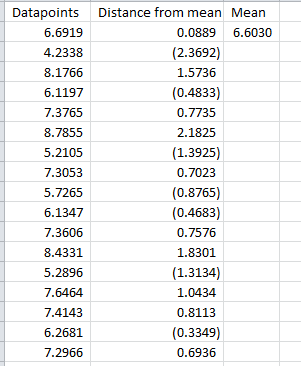

Our new concern is that we have negative values now (everything on the left of the mean). Even if sometimes we wish we had negative minutes, that is not going to happen anytime soon. 

Without going into too much details, our best option to get absolute data (no negative sign) while respecting mathematical rules, is to square our second column (as a reminder 1 x 1 = 1 and -1 x -1 = 1). This is what is called the variance.

Well, now we have square minutes (and way much that the initial distance calculated). I would like a handful of them every time I hit the snooze button of my alarm clock! But realistically, this is as useful as negative minutes. So now if we take the square root of this value, we get realistic minutes back.

Again, the standard deviation is only the average distance between your data points and your mean. To get it, you have to do a few mathematical pirouettes, but hopefully Excel, Minitab and other statistical software will do it for you!

Thursday, June 5, 2014

The introvert trainer

As a Lean Six Sigma BlackBelt, one of my roles is to train my neophyte colleagues to the methodology. The group I work for has developed an initiation training that every employee has to go through. This is how I ended having 15 sessions of training planned in six weeks.

For three hours, I speak to 10 people about wastes, bottlenecks and root cause analysis. I know my material thoroughly as I translated it into French and that I have a deep understanding of the topics I speak about. During each session, we use a simulation to teach the concepts, as we often do in the group for Lean Six Sigma training.

Surprisingly enough, I love to train people. I love to pass on my knowledge, and even though speaking to a fairly large group of colleagues is something I’m not entirely comfortable with, the sessions have been going pretty well so far.

Being so caught up into training makes introspection easier. I've been asking for feedback and looking back on how have done during my first few sessions. Here are some of the tips that work for me:

Before the training:
  • Get to know your material thoroughly: the more you know your material, the easier it will be to deliver it. Rehearse the training in your head a few days before and try to figure out the best way to deliver the message according to your audience and the message you want to deliver. 
  • Prepare a few examples to illustrate your words: examples are always hard to find on the spot. If you have enough ready, you can use them first and then either come with new ones linked to your audience or ask trainees for some of their own.
  • Make sure the logistics are flawless: if the room, time, breaks, food… need action from you when starting the training, you can’t relax and focus on the matter at hand. Make sure everyone, starting by you, is comfortable with the logistics. 
  • Choose your outfit wisely: your outfit, but most likely how comfortable you are in it will determine trainees’ first impression. Your outfit should reflect the topics you are teaching but also the kind of audience you have. 


During the training:
  • Use your stress to be energetic and don’t forget to smile: your stress can make your trainees uncomfortable but your smile will most likely make them smile back at you. Standing may help you focus on your speech and look more energetic.
  • Don't forget introductions: introduce yourself first to set the expectations and give participants a minute or two to prepare their introductions. If the training is long enough, you may want to use an icebreaker game.
  • State your agenda: give your participants an idea of what to expect during the training. Reassure them about their breaks and the time allowed to check on emails or make a call.
  • Listen to your audience (or watch their reactions): tell your trainees when they should ask questions and how much you want them to participate. Pay attention to their body language to see how they are doing and look at their faces to make sure they understand what you are saying. 
  • Try to include every participant, but never force someone to speak up: if you can, talk about projects related to your trainees, say their names when you talk to / about them. Make sure everyone has the opportunity to speak their minds, but don't insist if a participant doesn't want to speak.
  • Use examples related to your job but also to your personal experience / life: if your trainees come from different department / product lines of the company, make sure to use examples that all can understand. Use other companies to demonstrate your point. If you teach Lean Six Sigma, talk about your personal experience or life: many concepts can be used at home too.
  • Be patient with questions and praise the trainees who speak up: some participants will need more time to understand the concepts you are teaching. Remember that asking for an explanation can be a huge effort for them. When a trainee gives an example, try to say something positive and build on their example.


After the training:
  • Get feedback from trainees you trust to be honest or managers: if you have a clear understanding of what was well perceived and what can be improved, you can only get better. Also, seeking feedback should earn you respect from your peers.
  • Send an email to trainees to thank them for participating: follow up is key to leave a good impression. Besides, you may have documents, complementary information or pictures to send to the participants.
  •  Make sure participants will keep something from your training: it can be material, pictures, a small (corporate) gift, but also knowledge to apply at work and in their personal life.

Don't forget to have a good time! If the training is painful for you, it will be even worse for the participants... Good luck !

B