Showing posts with label six sigma. Show all posts

Wednesday, May 20, 2015

16 packing tips for a Lean / Kaizen Event

I've been working as a Project Manager for over four years now, but next week will only be the second time I'll have to travel for a Lean Event. After under packing last time to Raleigh (where we got a 20 miles radius power outage and snow), I've decided to make a list and not repeat my errors.

Here are a few tips for packing for a Lean / Kaizen Event:
  • Adjust dress code accordingly: This is not your usual conference trip, you'll probably not be comfy wearing a suit and dress shoes (or a dress and heels) when following the production from step to step. Depending on your industry, you may get dirty (dusty in my case) or have to respect some standards (closed / safety shoes...). 
  • Review dress code with other participants beforehand: Everyone doesn't have the same definition of casual... I shown up in jeans, polo and Converse shoes to my last Lean Event when my colleague was in dress pants and shoes and a shirt. This time I've double checked that we'll be on the same page. Also, having a dress code similar to the on-site team you'll be working with will help you blend in and create a sense of team.
  • Keep temperature in mind: And not only outside temp, but also the facility's! Warehouses full of paper tend to be cooler than outside, except in the middle of summer when they're warmer than outside. If your industry involve strict temp control, cooking, cooling, etc. you want to be ready.
  • Make a list: It doesn't need to be fancy (or written), but having a list of what you want to travel with prevents you from forgetting things. Also, going over it a few time will help you spot the items you missed in that list. If you put your list in your suitcase before closing it, you'll be able to make sure you didn't forget anything when packing to go back home.
  • Choose the right luggage size: Obviously, if you plan on a carry on only, your suitcase size must fit requirements. I know I'll check in a bag, so I'll have to make sure my belongings are not crushed neither lost in a suitcase of the wrong size. I'll put everything I need on my bed and then decide with suitcase I need. 
  • Pack extras: If you're a Lean aficionado like me, you'll probably try to pack as efficiently as possible. But after a day walking the ground, you'll be happy to find a clean, dry pair of socks and a change of shoes.
  • Pack day and night outfits: Chances are you'll meet with your colleagues after hours, either to continue working or to relax. And even if you don't, you'll be happy to find clean and comfy clothes for the evening. 
  • Plan for the unplanned: I always have on me the basic meds in small quantity (pain and stomach meds, but also asthma and allergy meds), some band aids, gums, hair ties, tissues, lip balm, lint roller... 
  • Choose your method: Some like to fold, some to roll. I've tried packing cubes: very efficient but not wrinkle free. I've also tried to fold my clothes and putting them in a vacuum bag (obviously keeping air inside) and though it takes space in your bag, it was very effective. I'll try to roll this time (jeans mainly) and using the cubes for tops.
  • Prevent spills: I've bought some travel size products (tooth paste, dry shampoo) and some travel containers (to bring my own shampoo, conditioner, etc.). I also travel with some of my routine items (hair brush, make up...). I'll make sure they are closed tightly and will use a waterproof and spill-proof bag. That way, there shouldn't be any accident. 
  • Be strategic with make up: I usually use a lot of brushes and different products when I put make up on every day. When I travel, I like to bring a fluid foundation, an eye brow gel, a cream eye shadow, a mascara, a blusher and a brush. If I'm fancy, I'll add an eye liner pencil or an eye shadow palette and a couple of brushes. Usually, the team I'm working with is essentially made of men who don't care about my make up so I aim for the bare minimum amount to feel confident.
  • Working out or not working out, that is the question: I'll be working on routing, sitting in a room all day next week. Because I want to give myself an opportunity to stretch my legs and burn some energy in the evening, I'll bring yoga pants, a few shirts and runners. I'll wear my runners to travel and during evenings, the rest won't take much space.
  • Think about laundry: Add a big plastic bag to collect laundry during your stay and sorting your clothes coming back home easy. You can also steal the hotel laundry bag and turn it inside out so there's no confusion. 
  • Don't forget work essentials: Power cords and plug adapter are too often forgotten. Try to put them in your suitcase (unless it's too heavy and your carry on bag is half empty). Also, copy on your computer files you know you'll need and print time stamp / waste walk templates if needed. 
  • Print travel documents: I always have a printed version of my plane ticket, hotel reservation, car rental and any other key document (address of location, agenda if training...). I also have pictures of my passport and ID on my phone in case I loose anything.
  • Pack the right way: Shoes on the bottom of the suitcase, clothes on top, making full use of the pockets. If you gather / prep first and pack last, you should't need to add any last minute item that'll ruin your whole organization. 
When I arrive to my hotel, I like to unpack right away (including toiletries), because it make the generic hotel room feel more homey. It also help preventing wrinkle in your clothes. Just make sure you limit the number of places you spread your belongings in so you'll repack quickly and easily.

And finally, I like to leave my house clean before I travel, even though I can be in a laundry frenzy beforehand. That way, coming back feels much better!

Tuesday, April 28, 2015

Achievement

It took a while (partly because I changed regions) but I eventually got my Black Belt plaque today. 

After months working hard to get certified and not letting anyone alter my determination, it feels real at last.

I remember years struggling in math classes, teachers and fellow students but also former colleagues not believing in my skills. I remember the pain I felt during BB training trying to understand the concepts and fighting not to fell behind. I remember the surprise of some when I passed the written test and then the project presentation.

I've grown through all of it. I became stronger, learned more skills, proved myself to the business to the point that I got that position in North America I wanted so much. 

Don't let anyone walk on your dreams or tell you that you won't be able to accomplish it. If it is in your reach and you put the right amount of efforts to it, you may certainly will.

Monday, February 16, 2015

Standard deviation made easy

It took me a while to get comfortable with standard deviation. Even though it was explained to us thoroughly during Green Belt and Black Belt training, I used it without really understanding what was behind it. 

The big epiphany came while working for my Black Belt exam and getting my hands on Six Sigma for Dummies. It was the most brilliant explanation for it and I was glad to share it with my new team as we prepared our upcoming Green Belt training. Let me share it with you.

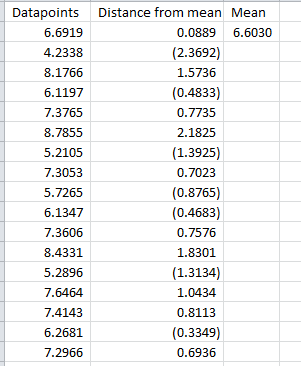
The standard deviation is the average distance between your mean and your data points. I know. That sounds almost too easy, but that is literally what the formula is. Let’s look into it in details.

Let’s take pizza delivery as an example. Whenever you order, you ask to be delivered at 7:00PM, hoping to be delivered no earlier than 6:30PM but no later than 7:30PM. These are your specifications limits: LSL=6:30 and USL=7:30. 

Over a year, you record the delivery time for each of your orders and plot them into a histogram. Obviously, you’ll want to calculate your mean to get the position of your data set. 


If we look at the mean, it seems acceptable. Though, imagine getting your pizza delivered at 4PM (or even 9PM) when asking it for 7… Let’s have a look at the spread of our data now. The bell curve is not really sharp and we have already pointed out some outliers.

What we need to know is how far are our data points from our central location. To get a real vision, we need to measure them all and compute a mean.


Our new concern is that we have negative values now (everything on the left of the mean). Even if sometimes we wish we had negative minutes, that is not going to happen anytime soon. 

Without going into too much details, our best option to get absolute data (no negative sign) while respecting mathematical rules, is to square our second column (as a reminder 1 x 1 = 1 and -1 x -1 = 1). This is what is called the variance.

Well, now we have square minutes (and way much that the initial distance calculated). I would like a handful of them every time I hit the snooze button of my alarm clock! But realistically, this is as useful as negative minutes. So now if we take the square root of this value, we get realistic minutes back.

Again, the standard deviation is only the average distance between your data points and your mean. To get it, you have to do a few mathematical pirouettes, but hopefully Excel, Minitab and other statistical software will do it for you!

Tuesday, October 28, 2014

p value memo

During BlackBelt training, I had a hard time understanding what the p value is, why it appears so often for different reasons and how to read it.

Then on a daily basis as a Lean Six Sigma project leader, I was tired of looking throughout my books to find how to interpret a test.

That is why I put together (amongst other tools) a p value memo:


Today, I still have a print of it on my desk and use it on a regular basis, just to be sure. Hopefully it can help others too!

And by the way, I got my BlackBelt certification last week!

Wednesday, September 10, 2014

I am the Captain of my own ship

The week before I left, two major events happened:
1. I won the European Project of the Year Award for FY14,
2. I sent my BlackBelt project deck for certification. I only have the presentation left before I can be certified.

After this great week, I took advantage of my holidays and thought about my job and my career. I wondered what key element makes me a successful Project Leader. Obviously, there is technical knowledge, but it is not always the key to success. Introversion is a distinctive element from my peers, though sometimes it can make a project go south. What really makes a difference is what I call having a sense of vision.

To me, having a sense of vision is to be able to visualize, to imagine what a solution / software / process will look like before it goes live. At home, it translates in having a clear idea what the room will look like before you start renovating it. As my parents both have vision, I thought for years that it was common to everyone. Leading projects, I discovered that not only it is not the case, but also that it comes really handy.

Because I am comfortable with IT topics, I often end working on software related projects. I have done a data entry software demo to the Unions Rep a couple of months ago and told my audience that the software will be in French (it was in English at the time) and that the field will be the same that the ones used today for each Customer (when I was showing a generic US customer configuration). In my head, I see pretty clearly what it is going to look like. My audience had a hard time doing the same, creating push back and fear of change. 

As a Project Leader, I am the one with a vision. As I am not my Team Members' Manager, I do my best to be their leader using vision and persuasion. I like the metaphor of acting as the Captain of a ship to describe the role of a Project Leader. Let take that journey together.


As I just said, I am the captain of the ship (Project Leader). I have been asked  and given the means by the Governor (Sponsor) to complete a mission (solve an issue). I need to gather a Crew (Team) depending of the size of my ship and destination (project). My Crew is made of a few volunteers, but mainly of people who take part of this journey out of necessity. 

My role is to convince them that I know where we are going (solution) and that no matter how hard the journey will get (DMAIC steps), it will be worth it and they will get their gold (benefits from the project). Food and water (investments and resources) are limited on board and need to be managed properly.

Once at sea, them leaving will make it harder to navigate (lead the project to success). They may lose their lives (from credibility to job) in the process of leaving. Once we get to the promised land (Control phase), we celebrate and share the gold (benefits). Then we move on to our next mission (project).

Monday, June 23, 2014

14 organizational tips for Project Leaders (and everyone else)

I have started my career in Communication and then became a Continuous Improvement Project Leader. Both roles demand a strict organization, as multitasking and unplanned tasks were key to succeed.

I have developed an organization that works for myself and may help you get more organized. Here are a few tips that should make your life easier:

At your work space:
  • Do not over sort: Pinterest should have a "do not try this at home" mention on their desk pictures. If your sorting system is too complex (even though it is allegedly pretty), you will quickly stop using it and start creating a mess. This also applies to your computer and folders (and at home!).
  • Be proactive: Sort your documents and clean your desk / computer / inbox less but more often. It will seem like it is a smaller and easier task and prevent clustering. 
  • Archive old projects: Once a project is completed, sort the paper documents associated to that project. Throw away what is not important and put the rest in a folder and in a carton. You can also create a CD with the project data and put it in the folder.
This is my desk at the end of the day. I use my laptop screen for emails and the second screen for everything else. I had to remove my sticky note for a board visit, but they usually are on the glasses between my colleagues and I.

Managing your tasks:
  • Use the 5 Whys: When getting assigned a task, use the 5 Whys (ask why until you reach the root cause) to make sure you understand what and why you will be performing. You will save time and avoid confusion, rework and frustration.
  • Lists & sticky notes: Write down the tasks you need to perform (lists), the information you can't forget (sticky notes). Review them on a daily basis and get rid of what has been done. There is nothing more rewarding than crossing every item of a to-do list!
E-Organization:
  • Color code your inbox / calendar: Define a color by project (or type of task / department / site...) and apply it to your emails and calendar. You can then sort your emails by color to get a good idea of the workload for each project. It also applies to your calendar: you'll see instantly how your time will be used.
  • Create one folder per project: One folder in your inbox and one on your drive for each project. You can then create sub-folders for specific topics (and an "Old" one for previous versions of your docs).
  • Number your folders: By giving each folder a number, they will automatically be sorted by chronological order. You can also access them quickly by typing the number you are looking for. If you use a project management system that automatically gives a reference number to your projects, you can use them.
  • Inbox is for emails to work on: Sort everything that doesn't need (anymore) an action from you in its right folder. That leaves you with only the tasks at hand in your inbox.
  • Use rules to sort your emails: Emails generated by a system or information given to a number of people can be sorted automatically in the right folder so you look at them only if you need to. You can also create a "Cc" folder in which you send automatically every email for which you are in Cc (and not the recipient). That should clean your inbox (especially if you are a manager).
Quick access to my personal emails, to the folder where all communications go, projects sorted by number and color coding

Planning your time:
  • Put everything in your calendar: Make sure to have every meeting in your calendar, but also the tasks you need to perform on your own, planned phone calls, appointments, etc. That is the only way not to forget anything. Don't forget to use the Private function!
  • Be realistic: No need to plan 1 hour for a meeting when you know it is going to take 2. Planning more time than necessary will make it easier if the meeting runs late. It will also be less overwhelming if you are late according to your planning or can't do everything that was planned. 
  • Keep some free time: Unexpected events happen all the time. If you have free slots in your agenda, it will be easier to face unpredictable events / tasks.
  • Only one meeting at the time: This sounds like the dumbest piece of advice, though it is rarely applied! You won't be able to attend two meetings at the same time. Sort your priorities and make a choice. You will be more effective fully focused on one meeting than partly attending two.
Blue/Green is for training, red for mentoring, yellow for reporting and green for a data entry project

Any additional tip? Feel free to leave a comment, I'll add it in the right section!

Thursday, June 5, 2014

The introvert trainer

As a Lean Six Sigma BlackBelt, one of my roles is to train my neophyte colleagues to the methodology. The group I work for has developed an initiation training that every employee has to go through. This is how I ended having 15 sessions of training planned in six weeks.

For three hours, I speak to 10 people about wastes, bottlenecks and root cause analysis. I know my material thoroughly as I translated it into French and that I have a deep understanding of the topics I speak about. During each session, we use a simulation to teach the concepts, as we often do in the group for Lean Six Sigma training.

Surprisingly enough, I love to train people. I love to pass on my knowledge, and even though speaking to a fairly large group of colleagues is something I’m not entirely comfortable with, the sessions have been going pretty well so far.

Being so caught up into training makes introspection easier. I've been asking for feedback and looking back on how have done during my first few sessions. Here are some of the tips that work for me:

Before the training:
  • Get to know your material thoroughly: the more you know your material, the easier it will be to deliver it. Rehearse the training in your head a few days before and try to figure out the best way to deliver the message according to your audience and the message you want to deliver. 
  • Prepare a few examples to illustrate your words: examples are always hard to find on the spot. If you have enough ready, you can use them first and then either come with new ones linked to your audience or ask trainees for some of their own.
  • Make sure the logistics are flawless: if the room, time, breaks, food… need action from you when starting the training, you can’t relax and focus on the matter at hand. Make sure everyone, starting by you, is comfortable with the logistics. 
  • Choose your outfit wisely: your outfit, but most likely how comfortable you are in it will determine trainees’ first impression. Your outfit should reflect the topics you are teaching but also the kind of audience you have. 


During the training:
  • Use your stress to be energetic and don’t forget to smile: your stress can make your trainees uncomfortable but your smile will most likely make them smile back at you. Standing may help you focus on your speech and look more energetic.
  • Don't forget introductions: introduce yourself first to set the expectations and give participants a minute or two to prepare their introductions. If the training is long enough, you may want to use an icebreaker game.
  • State your agenda: give your participants an idea of what to expect during the training. Reassure them about their breaks and the time allowed to check on emails or make a call.
  • Listen to your audience (or watch their reactions): tell your trainees when they should ask questions and how much you want them to participate. Pay attention to their body language to see how they are doing and look at their faces to make sure they understand what you are saying. 
  • Try to include every participant, but never force someone to speak up: if you can, talk about projects related to your trainees, say their names when you talk to / about them. Make sure everyone has the opportunity to speak their minds, but don't insist if a participant doesn't want to speak.
  • Use examples related to your job but also to your personal experience / life: if your trainees come from different department / product lines of the company, make sure to use examples that all can understand. Use other companies to demonstrate your point. If you teach Lean Six Sigma, talk about your personal experience or life: many concepts can be used at home too.
  • Be patient with questions and praise the trainees who speak up: some participants will need more time to understand the concepts you are teaching. Remember that asking for an explanation can be a huge effort for them. When a trainee gives an example, try to say something positive and build on their example.


After the training:
  • Get feedback from trainees you trust to be honest or managers: if you have a clear understanding of what was well perceived and what can be improved, you can only get better. Also, seeking feedback should earn you respect from your peers.
  • Send an email to trainees to thank them for participating: follow up is key to leave a good impression. Besides, you may have documents, complementary information or pictures to send to the participants.
  •  Make sure participants will keep something from your training: it can be material, pictures, a small (corporate) gift, but also knowledge to apply at work and in their personal life.

Don't forget to have a good time! If the training is painful for you, it will be even worse for the participants... Good luck !

B

Monday, May 26, 2014

An happy introvert

About two months ago, I discovered I am an introvert. For the first time in my life, I've been able to put words, but also to better understand how I felt for 28 years.

I've always been considered as a quiet child. I could play on my own for hours without needing any attention from the grown ups around me. I've always enjoyed the company of books. Even before I could read, I would hide books under my pillow and "read" them after my parents would put me to bed. Needless say I always brought books with me in holidays. (Imagine my happiness when discovering in my mid twenties the magic of unlimited number of ebooks on my iPad!).

At school, I tended to have a small group of friends rather than being the popular one. I've been friends with extroverts for years. I guess they acted as buffer, or shields, between the others in the class / school and myself. I'm not a sport person, and team sports tend to make me really nervous. As do any situation I cannot really imagine, prepare in my head and get ready for.

At the tender age of 9, I decided I was going to become a journalist. My goal was to make sure that everyone knew the truth and to help people communicate. Also, I really loved to write. I've been through middle and high school with this goal in mind. I tried to enter one of the few reknown French journalism schools but failed by far. I managed to get a summer job at the local newspaper, to get some experience in the field and earn some money. I hated every minute of it. I required me to attend crowded events and to talk to people I didn't know. I had to ask them unwanted questions. It was a great source of anxiety and make me realise it was not a job for me.

I directed myself toward communication. Some aspects of the job were fairly close to journalism, but at least relationships were held under the rules of the company. I was an employee as any other, and was due respect and help for this fact only.

After 3 years in communication, I was offered the opportunity to work as a full time continuous improvement project leader and to be Lean Six Sigma Blackbelt trained (and hopefully certified sometime soon). Again, I was facing the unknown everyday and had to go towards people when my guts would ask for some peace and quiet environment.

And after 6 years working for the same company, I was invited to a Leadership and Development. Not knowing what to expect was hard and make me reluctant to really engage. I took the tests I was asked to before the training, but without really understanding what it would bring me.

I have learned that how I feel is normal - just not to the extroverts around me. I have been able to identify stressful situations and react better to them. I have been able to say to my extrovert husband that even though I love him, too much interactions with people during this particular work day make me want to be on my own for a while.

Knowing myself better doesn't change the fact that working on an open space or training people is very much outside of my comfort zone. Though, that knowledge and my (nerdy) love for statistics pushed me to start a blog and my own prediction model. 

Indeed, my goal here is to capture data about my interactions with the outside world, to measure when I have my fair share for the day and thus be able to predict the "how much" and "what kind" of interactions I can take in a day (and also measure the minimal threshold for an extrovert).

I'll take you with me on my journey and would be glad to share thoughts and suggestions.

B